

Fif. 1
Fif. 2

Fig. 3 Fig. 4 Fig. 5
1.5 For metric thread O-Ring groove JB standard is type Fing. 5, but we suggest that the type Fig. 3 should be chosen and make a annotation when order. If no annotation we produce as type Fig. 5 general. For ORFS O-Ring groove, we produce as type Fig. 3 only.
2. O-Ring Face Seal Fittings Assembly Instructions
2.1 Assembly
a) As shown in Fig. 1, the tube end is cut squarly(within±1°) before assemblied, deburr the O. D. and I. D. of the tube, remove all oil and oxide, weld after put the nut. As shown in Fig. 2, the tube is flanged to 90°with special equipment after cut, diameter D should fall between diameter D1 and D2, see Fig. 6.

Fig. 6
b) The fitting body should be installed O-Ring firstly.
c) As shown in Fig. 1 or Fig. 2, place tube assembly against the fitting body so that the face of the weld tube(or flanged steel tube) comes in full contact with the O-Ring. Tighten the nut onto the fitting body by hand .then tighten it to the recommended torque with a torque wrench.If torque wrenches are not available, tighen 1/4 to 1/2 turn with general wrench .
2.2 Reassembly
Because the sealing surf aces flat and perpendicular to the installtion force, the O-Ring may be distorted duri ng assembly. The O-Ring should be in spected at each disassembly and replaced when necessary.
2.3 Leakage reason
a) The O-Ring is installed in the face seal groove improperly.
b) The O-Ring is damaged.
c) The sealing surface, the weld tube or the flange are not flat, or have another fault affecting sealing.
d) The flange is too large or too small that the O-Ring can’t be compressed.
e) The O-Ring material is not suit for working temperature.
g) The O-Ring hardness is not enough.
h) The connected nut is loosen.
1. Bite Type Tube Fittings Instructions
1.1 Bite tybe fitting consists of three parts: body, cutting ring and nut .When tightening nut, cutting ring is driven forward on the tube then bites the tube with the adge of cutting ring, this is how sealing is achieved and results in internal ridge inside the tube. see Fig. 7 .

Fig. 7
1.2 The tube connection side of fitting is manufactured in accordance with standard: DIN 3861
1.3 In general, body and nuts’ surface is plated zinc. Bite type fitting can be used in system with Max 63 MPa. The connection tube O. D. is Max. 42mm.
2. Bite Type Tube Fittings Assembly Instructions
2.1 Assembly
a) Cut the tube at right angle and de-burr inside and outside of tube end .Minimum straight length of tube from the starting point of tube bend to the tube bend to the tube end may be 3 times height of the nut.
b) Set a nut and cutting ring on the tube .Make sure the cutting ring and the nut are facing the fitting.
c) Lubricate the pre-assembly fitting body threads and cutting ring .insert tu be end into fitting body until it is firmly seated on bottom (fitting shoulder) and hand-tighten the nut.
d) Tighten nut until ferrule grips tube which is felt by a noticeab le increase in torque (in crease in force).
e) Tighten nut 1/2 of a turn after increase in force.
f) Disassembly the pre-assembly fitting body .Check penetration of cutting edge . A visible ring of material should fill the space in front of the profile ring end face. Profile ring may turn on tube .bur should not be capble of axial displacement.
g) Lubricate the fitting body to be subsequently installed .Tighten nut untila noticeable increase in force is required. Tighten nut by 1/2 of a turn beyond this point for final assembly.
2.2 Reassembly
ensure this, parts must be clean and free of defects.
a) Insert the tube into fitting body untilcutting ring seats firmly in the fitting and hand-tighten the nut.
b) Tighten the nut with a wrench by holding the fitting body with a backup wrench until a sharp rise in torque is felt.Further tighten the nut 1/4 to 1/2 turn.
2.3 Checking up the bite condition
All bite type fitting must be disassembled prior to service to check up if small ridge inside the tube is completely formed around front edge of cutting ring .Otherwise tighten slightly more to have it .Cutting ring may rotate on the tube that doesn’t mean wrong installation .The cutting ring shall be refitted once the nut is retightened.
2.4 Leakage reason
a) When the tube is not fully bottomed
b) When the nut is nut tightened enough
c) When the tube is of scratches or oval
d) When the tube is extremely hard.
1. Flared Tube Fittings Instructions
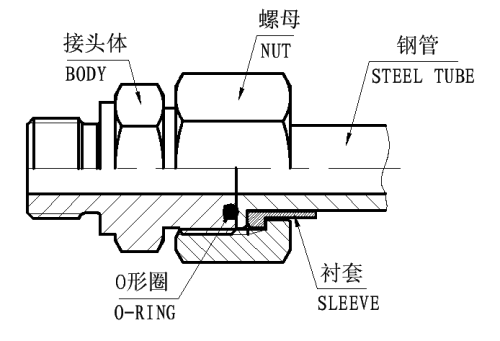
1.1 As shown in Fig . 8, the fitting consists of three pieces: the body, sleeve and nut. The tube end is flared at a 37° angleand held between the fitting nose and the sleeve with the nut, providing a metal to metal seal between the fitting nose and the flare. The advantage of sleeve is reducing vibration and fatigue of tube, the stee; tube will not turn when tighten the nut.

Fig . 8
1.2 The flared tube fitting has two connected thread: metric thread and JIC thread
1.3 it is easy to assemble without weld. It is especially suited for low and medium pressure systems. As metal to metal seal, it allows wide operting temperature range.
2. Flared Tube Fittings Assembly Insturctions
2.1 Assembly
a) Cut tube reasonably square (within±1°),deburr the I. D. of the tube, remove the dirt. set a nut and sleeve on the tube, the tube is flared with special equipment, diameter D should fall between diameter D1 and D2, see Fig .9.

Fig . 9
b) Over half of the leakage with flared fittings is caused by impoper flaring or installation, when saaembled, the axis of the tube, the tube flare and the fitting nose should be concentric.
c) Screw the nut onto the fitting body by hand and tighten it to the recommended torque with a torque wrench. if torque wrenches are not available, tighten 1 to 2 turns with general wrench .In general, the smallfitting is tighten about 1 turn and the large fitting is tighten about 2 turns.
2.2 Reassembly
Fitting can be used many times. To ensure this, part must be clean and free of defects .no tube cracked.
2.3 Leakage reason
a) When assembled, the axis of the tube, the tube flare and the fitting nose are not concentric, force the tube to the station.
b) The tighten force is too large or too small.
c) The tube flare cracked.
d) The fitting body or the tube flare is collapsed.
e) The connected nut is loosen.
f) The sealing suface is damaged for longer torque or reassembly time after time.
g) The tube flare is too large or too small, so the seal between the fitting nose and the tube flare is not effective.
Routing of tube lines should pay attention to the following.
1. The length of tube should be short and tube O. D. should be suitable, the energy will loss if the velocity is too large.
2. The tube connection should avoid strain, it is good that have a bending part. see Fig. 1.

Fig . 1
3. The tube bending radius is large as possible. The min. bending radius is about 2.5 times of the O. D. The tube end should be straight and the spacing is above 2 times of the tube nut . see Fig .2

Rmin=2.5D H≥2h
Fig. 2
4. Fatigue failure due to mechanical vibration accounts for the majority of tube line failures. when the tube line is longer, we can use tube clamps to support the system. Proper clamping of the tube can reduce system noise. Recommended tube clamp spacing as shown in Fig. 3 and table 1.

Fig. 3
Table 3
(mm) TUBE O.D. | A(mm) CLAMP SPACING | B(mm) CLAMP SPACING | C(mm) CLAMP SPACING |
6-12.7 | 50 | 900 | 100 |
15.9-22.2 | 100 | 1200 | 200 |
25.4 | 100 | 1500 | 200 |
37.8-38.1 | 150 | 2100 | 300 |
48.3 | 150 | 2700 | 300 |
5. Get around obstructions without using excessive amount of 90°bends. Pressure drop due to one 90°bend is greater than that due to two 45°bends. See Fig. 4
 Fig. 4
6. Keep tube lines away from components that require regular maintenance.

Fig. 5
7. Have a neat appearance and allow for easy trouble-shooting, maintenance and repair. See Fig. 
Fig. 6